 Celebrate with up to 80% off
What is a deepfake? Meaning, risks, and how to spot one



A deepfake is synthetic media (images, audio, or video) created using artificial intelligence (AI) with the goal of making it appear real and authentic. These systems learn from large datasets and can replace faces, mimic voices, or generate entirely fabricated scenes.
While the technology has creative and educational uses, it also introduces serious risks, including misinformation, fraud, and identity manipulation.
Definition and overview of deepfakes
A deepfake is a piece of media that looks or sounds real but is actually fake. It might show someone saying or doing something they never actually did. The term comes from “deep learning,” a type of AI that learns from large sets of existing images, videos, or audio recordings and uses those patterns to create new, realistic-looking content, and “fake,” which describes the manipulated nature of the media. It has become a common tool in AI-enabled scams.
Why deepfakes matter today
Deepfakes matter because they make it harder to trust what is seen or heard online. As the technology improves, fake content can look extremely realistic, even to trained eyes.
This creates risks in areas like politics, journalism, business communication, and personal reputation. It also increases the chance of scams and fraud, where fake voices or videos are used to impersonate real people.
How deepfakes connect to misinformation
Deepfakes are closely linked to misinformation because they can be used to spread false or misleading content in a highly convincing way. They can be used as “evidence” in video or audio form.
This makes misinformation more powerful, as people tend to trust visual and audio content more than text. As a result, deepfakes can be used to manipulate public opinion or create confusion during important events.
How deepfake technology works
Deepfake technology relies on AI systems that learn patterns from large amounts of real-world data. These systems analyze how faces move, how voices sound, and how people express emotions, then use those patterns to generate new, synthetic content.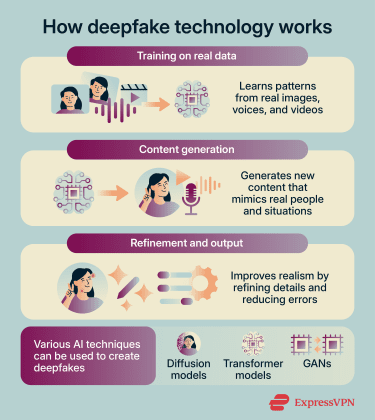
The core of deepfake technology is machine learning (ML), a type of AI that improves through experience. Here are the key approaches that are widely used:
- Diffusion models: Create content by starting with random noise and gradually refining it into a clear image, video frame, or audio sample. This method is commonly used in modern AI systems for producing high-quality fakes.
- Transformer models: Generate content by identifying and predicting patterns in large datasets. Transformer-based models are widely used in modern AI systems and can help create realistic text, voices, images, and videos that may be incorporated into deepfakes.
- Generative adversarial networks (GANs): Historically one of the most important deepfake technologies, GANs use two competing AI models: one generates fake content, while the other tries to detect it. This back-and-forth process continues until the generated output becomes highly realistic. However, while GANs played a major role in early deepfakes, they’re less widely used today than diffusion and transformer-based models.
Learn more: Uses, benefits, and risks of generative AI in cybersecurity.
Types of deepfakes
Deepfakes come in several forms, depending on the type of media being manipulated. The most common include video, image, and audio-based deepfakes.
- Deepfake videos: These are AI-generated or AI-manipulated videos that depict people saying or doing things that never happened. Some deepfakes alter existing footage, while others generate entirely new video content designed to resemble a real person.
- Deepfake images: These are AI-generated or AI-manipulated images that depict people, events, or scenes that don’t exist or didn’t occur as shown. Like videos, some are created by modifying real photographs, and some are generated entirely from scratch.
- AI voice scams and audio deepfakes: These are audio samples modified or created by AI to replicate a person’s voice and generate new spoken audio. The output can mimic tone, accent, and speaking style, making it sound like the person is saying things they never actually said.
Deepfake vs. synthetic media
Deepfakes are a subset of synthetic media. Synthetic media is a broad term that refers to any content generated or heavily modified using AI, including text, images, audio, and video.
Deepfakes specifically focus on the realistic manipulation of human likeness, such as swapping faces or cloning voices. In other words, all deepfakes are synthetic media, but not all synthetic media instances are deepfakes.
Deepfake vs. shallowfake
Shallowfakes and deepfakes are often confused, but they differ in both complexity and how they’re created. Understanding the distinction helps clarify why some manipulated media is easier to spot than others and why AI-based fakes present a greater challenge.
| Aspect | Shallowfake | Deepfake |
| Definition | A simpler form of media manipulation that doesn’t use advanced AI | A more advanced form of manipulated media created using AI to generate new content |
| How it’s made | Basic editing tools like cutting, slowing down, speeding up, or rearranging existing footage | AI models trained on real data to create or replace faces, voices, or actions in media |
| Level of modification | Alters existing content without using generative AI to produce new visuals or audio | Generates new synthetic content that can replace or mimic real people |
| Realism and detection | Often easier to spot due to visible edits, inconsistencies, or context changes | Can appear highly realistic and is harder to distinguish from real footage due to fine detail replication |
Tip: You can learn more about synthetic media in our dedicated AI lookalikes guide.
Common uses of deepfake technology
Deepfake technology is used across entertainment, education, business, and online communication. Some uses are creative or practical, while others raise serious ethical concerns.
Acceptable uses for deepfake technology
In controlled and transparent situations, deepfake technology can support creative projects, training programs, and digital experiences. Many organizations use synthetic media tools to reduce production costs, improve accessibility, or create realistic simulations.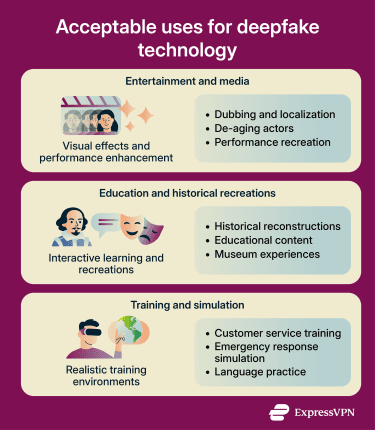
Entertainment and media
Film studios and content creators use deepfake technology for visual effects, dubbing, de-aging actors, and recreating performances. For example, the film Here reportedly used generative AI technology to de-age Tom Hanks and other actors during production.
In some cases, similar AI-based techniques can help restore damaged footage or improve localization by adjusting lip movements to match translated dialogue. For example, U.K. company Flawless developed technology that digitally alters actors’ lip movements so dubbed dialogue appears more natural in different languages.
Education and historical recreations
Educational projects can use synthetic media to recreate historical figures or events. Museums, documentaries, and training platforms may use AI-generated voices or animations to make lessons easier to understand and more interactive.
For example, in 2019, the Dalí Lives exhibit in the Dalí Museum in St. Petersburg, Florida, used AI and deepfake technology to create an interactive digital version of Salvador Dalí that could speak with museum visitors.
Training and simulation
Deepfake technology can support professional training. Simulated conversations and realistic digital avatars are sometimes used in customer service training, emergency response exercises, and language learning environments.
Harmful uses of deepfakes
While some applications are legitimate, deepfakes are also used deceptively and maliciously. As the technology becomes more realistic and accessible, concerns around abuse continue to grow.
Misinformation campaigns
As mentioned above, one of the most concerning ways of abusing deepfakes is using them to spread false information. Manipulated media may be shared online to influence public opinion, damage trust, or create confusion around important events.
One example is AI-generated deepfake videos of real doctors that circulated on social media platforms promoting misleading health claims and unverified supplements. The manipulated clips altered real interviews and public footage to make it appear as though medical professionals were endorsing products they had never actually supported.
Scams, fraud, and social engineering
Cybercriminals may use cloned voices or fabricated videos to impersonate trusted individuals. These tactics can support scams, financial fraud, extortion, or social engineering attacks by making fake requests appear legitimate.
One widely reported example involved a finance worker at a multinational company who was tricked into transferring millions of dollars. The fraudsters used AI-generated deepfake video calls to impersonate a senior executive during a virtual meeting.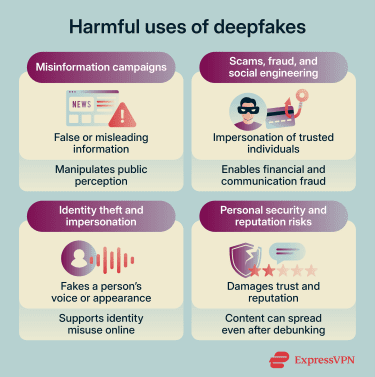
Identity theft and impersonation
Deepfake technology can imitate a person’s appearance or voice closely enough to misrepresent their identity online. Sometimes, attackers may use publicly available photos, videos, or audio clips to create convincing impersonations.
Recent industry reports show how quickly this type of impersonation is growing. According to analysis from Deloitte, AI-enabled fraud, including deepfake-driven identity theft, could contribute to losses of up to $40 billion in the U.S. by 2027, reflecting rapid growth in synthetic identity abuse.
Personal security and reputation risks
False or manipulated media can damage reputations, relationships, and public trust. Even when a deepfake is eventually proven false, the content may continue spreading online, making reputational harm difficult to reverse.
How to spot deepfakes
Modern deepfakes can look and sound highly convincing, and advances in AI have made obvious visual and audio artifacts less common than they once were. While some manipulated media still contains small inconsistencies, many high-quality deepfakes don’t show any visible signs of editing.
This means that identifying deepfakes often requires looking beyond the content itself. Verifying the source, checking whether the material appears in reputable news coverage, examining metadata where available, and using content authentication or forensic tools can provide more reliable evidence than visual inspection alone.
Common signs of (low-quality) deepfake content
Modern AI systems can generate highly realistic images, audio, and video, making deepfakes practically impossible to identify through visual inspection alone. However, many deepfakes created with consumer tools or shared on social media still contain inconsistencies that may indicate manipulation.
Here are a few red flags to watch out for:
- Unnatural facial movements: Facial expressions may appear stiff, exaggerated, or slightly delayed. Eye movement, blinking, and emotional reactions sometimes look unnatural or fail to match the situation.
- Poor lip syncing or audio mismatch: The spoken audio won’t fully align with the mouth movements. Other times, speech patterns sound robotic, flat, or inconsistent with the person’s usual voice.
- Odd lighting, shadows, or skin texture: Lighting may look uneven across the face and body, especially around the edges of the face. Skin texture can also appear overly smooth, blurry, or inconsistent between frames.
- Inconsistent body movement or perspective: Body posture, hand movement, or camera angles may shift unnaturally. Objects in the background can also appear distorted or out of place during movement.
- Suspicious source or unusual context: Deepfakes are often shared through unverified accounts, reposts, or edited clips without clear sources. Content designed to provoke strong emotional reactions or appear unusually sensational should be treated carefully until verified.
Tools for detecting deepfakes
Researchers, journalists, and security teams use several methods to verify suspicious media:
- Digital forensics tools: These examine media files for signs of editing or manipulation, including metadata, compression artifacts, frame inconsistencies, and pixel-level anomalies.
- Reverse image and video search: These help trace where an image or video first appeared online, which can reveal whether it was reposted, used out of context, or altered.
- AI-based deepfake detection software: These systems use ML to detect patterns associated with synthetic media, such as unusual facial movement, voice anomalies, lighting mismatches, or other technical artifacts.
Other ways to detect deepfakes
In addition to technical analysis tools, there are practical verification methods that help confirm whether a request or communication you’ve received is genuine or might be a deepfake:
- Safe word verification: A pre-agreed word or phrase can be used to confirm identity during sensitive conversations. This helps verify that a request is genuine, especially if someone’s voice or image may have been impersonated.
- Out-of-band verification: Identity is confirmed using a separate communication channel, such as calling a known phone number or using an official app instead of replying to the original message. This reduces the risk of trusting a fake or manipulated source.
- Multi-factor authentication (MFA): Extra verification steps are required before access is granted or actions are approved. This makes it harder for attackers to gain access even if they manage to copy or spoof part of a user’s identity, such as through a deepfake voice, video, or image used to impersonate someone during a verification attempt.
Important: No single method is foolproof, as detection accuracy depends on the quality of the media, how it has been edited, and how advanced the technology is. Verification should combine multiple tools and cross-checking results rather than relying on a single indicator.
Are deepfakes legal?
A deepfake isn’t automatically illegal. Legality depends on how it’s used and the laws in a specific country. Problems usually arise when deepfakes are used to deceive, defame, or exploit someone.
Regulations and compliance considerations
Many regions are introducing rules to address synthetic media, with a focus on transparency, disclosure, and preventing misuse in sensitive areas like elections and advertising.
In the E.U., the Artificial Intelligence Act (AI Act) introduces transparency requirements for AI-generated content, including rules that require certain synthetic media to be clearly labeled so users aren’t misled.
In the U.S., regulation is more fragmented and handled at both the federal and state levels. The Federal Trade Commission (FTC) can take action against deceptive AI-generated content under existing consumer protection laws.
At the federal level, newer proposals aim to address specific risks posed by synthetic media. The NO FAKES Act focuses on preventing the unauthorized use of a person’s likeness, voice, or identity in AI-generated audio and video, particularly where impersonation or reputational harm is involved.
The TAKE IT DOWN Act, signed into law in 2025, targets a narrower but high-impact category of harm: non-consensual intimate imagery (including AI-generated deepfakes). It requires platforms to remove such content quickly once it’s reported.
Together, these reflect an approach that’s still evolving, combining existing consumer protection enforcement with targeted legislation.
How individuals and businesses can reduce deepfake risk
Reducing deepfake risk involves awareness and practical safeguards. This includes checking sources carefully, verifying identities, and using secure communication methods when sharing sensitive information.
What to do if you suspect a deepfake
If the media appears to be a deepfake, it shouldn’t be shared further until it has been verified. It can be checked against trusted sources, reported to platform moderators, or escalated to relevant security or fact-checking channels depending on the context.
In cases involving fraud, impersonation, or financial harm, it can also be reported to the following:
- In the U.S.: Internet Crime Complaint Center (IC3)
- In the E.U.: Europol
- In the U.K.: ReportFraud
- In Australia: eSafety Commissioner
- In Canada: Canadian Anti-Fraud Centre
Verification steps before sharing media
Before sharing suspicious media, follow a structured verification process:
- Check the source to confirm whether it’s a trusted or verified publisher.
- Cross-check coverage to see whether reputable outlets are reporting the same content.
- Look for context gaps that may indicate the media has been taken out of context or edited.
- Inspect for manipulation signs such as visual or audio inconsistencies.
- Confirm with official channels when the content involves organizations, public figures, or sensitive events.
Corporate best practices for deepfake protection
Deepfake risks apply to both individuals and organizations. However, businesses are often high-value targets due to their access to financial systems, customer data, and public trust. As a result, they typically implement more structured security measures to reduce exposure, including:
- Approval workflows and identity checks: Sensitive requests, especially financial or operational changes, should require multi-step approval processes and verified identity checks to reduce the risk of impersonation.
- Employee awareness and response training: Staff training helps employees recognize suspicious requests and understand how deepfakes may be used in scams.
- An incident response plan: This should clearly explain what to do if a deepfake attack happens. It should include who needs to be contacted, how to communicate safely, any legal steps that may be required, and the technical actions needed to contain and respond to the incident.
Future of deepfake technology
Deepfake technology is expected to keep improving as AI systems become more advanced and widely available. This will likely lead to more realistic synthetic media but also stronger tools for detecting and managing it.
Predictions and trends
Deepfakes are likely to become faster and cheaper to produce, while also becoming harder to distinguish from real recordings as generative AI improves. Future systems may produce more convincing facial expressions, voice emotion, and live impersonation, though real-time use still has technical limits.
As access to these tools becomes more widespread, their use may expand in media and education, but so may misuse in scams, fraud, and misinformation.
The evolution of detection and verification technologies
As deepfakes improve, detection technologies are also evolving. AI systems are being trained to look for subtle patterns that may indicate manipulation, including facial movement anomalies, unnatural speech patterns, and digital artifacts.
New verification methods are also emerging, including content authentication systems such as SynthID, which embed invisible watermarks into AI-generated content to indicate when it was created by AI. These approaches shift the focus from visually identifying fakes to verifying the origin of media.
Preparing for more realistic AI-generated media
Agencies such as the National Institute of Standards and Technology (NIST) and Europol advise that, as AI-generated media becomes more realistic, individuals and organizations must shift from visual trust to verification-based approaches, using trusted sources, authentication systems, and structured validation processes before accepting digital content as authentic.
FAQ
Can deepfake audio be detected?
Why are deepfakes becoming more realistic?
Who is most at risk from deepfake scams?
Can AI-generated videos be traced back to their source?
What is the difference between a deepfake and an AI avatar?
Can watermarking help identify AI-generated content?
How quickly can deepfake detection tools identify fake media?
What is face swapping and facial reenactment?